
The violin is the lead instrument in most classical orchestras around the world. But how well do we understand how this small and oddly shaped wooden box produces its rich sounds? There is still a lot to learn, but several hundred years of acoustical research have helped us to understand some of the physics behind the sounds that have captivated the human ear for centuries.
The sounds from a violin are very diverse, which also depend on the way and the kind of music the violin is being played. Its sounds can be described as dark, sonorous, vibrant, metallic, full sounding and intense. Violins are used in a variety of musical genres, including classical, country, irish fiddle, jazz, pop, arabic music and many other. In Indian music, several interpretation of violins have been used for centuries. The soft, clear and brilliant sounds of a violin make it a powerful and vivid instrument.
How was it born?
Let’s explore the history of violin.
Instruments like the ancient Greek Lyre were considered to be the first stringed instruments.
Vase painting of a women playing the ancient Greek Lyre.

The first bowed, stringed instruments may have originated in Central Asia with instruments such as the morin khuur from Mongolia.

The Morin Khuur, picture provided by Google Images

These instruments spread to India, China and the Middle East, leading to the development of Chinese Erhu and Esraj in India.
The Indian Esraj, picture provided by Google Images.
A woman playing the Chinese Erhu. Picture provided by Google Images.

The present day violin is inspired by these stringed instruments. It emerged in its present form in 16th century Northern Italy. The original designs were further elaborated taking inspiration from medieval European Vielle instrument, which itself was derived from Byzantine Lyra.

A Byzantine Lyra, provided by Google Images.
The earliest impressions of violin can be traced back to 1530. However, during those days, it was known as ‘Vilino’ in official documents.

Pictures and paintings of three string violins (called "Vilino(s)") are available from this era. This picture is provided by Google Images.
About two centuries later, in 1790, the violin was introduced in India. It came with military bandsmen (the musicians of the military) of the East India Company who helped Indians become familiar with this instrument.
Over the years, significant changes were introduced in the design of a violin. This includes 18th century changes in the length and angle of the neck. It also includes the development of a heavier bass bar. This is also the period when the Indian rendition of a violin was introduced.
Western music
Violins are most prominent in the Western classical tradition and in many varieties of folk music. They are also frequently used in genres of folk including country music and bluegrass music and in jazz. Electric violins are used in some forms of rock music. The violin is sometimes informally called a fiddle, particularly in Irish traditional music and bluegrass.They are the leading instrument in a orchestra.
In general, western violinists prefer to focus on the notes, and to maintain a single tempo just as elaborated by the composer.
In western music, the instrument is held at your neck, and is played either standing or seated in a chair.
Although, the violin has come to be played in many non-Western music cultures, including Indian music.

Antonio Vivaldi, a well-known violinist from the 18th century.

Lindsey Stirling, a violinist who plays pop music.
The violin in Indian music
Indian culture and violin aren’t foreign to each other, even if the instrument itself has foreign roots. As said before, Indians were introduced to the instrument by military bandsmen of the East Indian Company and their sounds or styles were adapted initially to suit Carnatic Music.
After learning how to play violin from this military bandmaster, Baluswami Dikshitar is considered to be the one who popularized the violin in Indian music. In the late 18th century and early 19th century, he adapted the style of playing violin to suit Carnatic Music. His brother, the famous Carnatic Composer Muthuswami Dikshitar, also helped with making this instrument popular.
Soon after, two styles of violin playing were designed in India – Carnatic (south of India) and Hindustani (and north). That is the reason why violin is such an essential part of South Indian Music. Over the years, the popularity of violin has expanded to pop and Bollywood music styles.
The biggest difference between Indian and Western Classical music is that the former is based very largely on improvisation, with emphasis on the creativity of the performer rather than on the exact reproduction of a composer's work. The system of Indian Classical music gives much more importance on melody.
Also, Indian violinists place an prominence on continuity.
The Indian violin has a different tuning. The scales have some similarities but, Indian music has scales which are more specific, because the music relies on melody.
There is a sense of rigor in improvisation that music feels structured and built on top of simple building blocks of melody and rhythm. The instrument is tuned E3, B3, E4 and B4 (instead of G3, D4, A4, and E5 like it is tuned in Western classical music.) Mostly, it is used to accommodate the vocalist or player, which makes it different from the Western version.
The last difference is in the way Indian violinists play their instruments.
For instance, they sit cross -legged, on the floor and rest the instrument on their right foot. As a result, this helps them keeping the violin in a stable position but also it ables them to move their bows more freely and adjust to playing around other classical Indian instruments.
It is very common that the Tabla or other percussion instruments accompany the violin when played. It is used as well to complement vocals.

A man playing the violin the indian way, provided by YoGEMS
How is it constructed so that sound is produced ?

This is the anatomy of the violin, seen by its front, side, back and inside, provided by Atelier Labussiere.
The body of the violin (called "belly" above) is made using two arched plates (also called "soundboard"). Different types of wood are used.
The back, the ribs and the neck of the violin are made from maple. It also carries a fingerboard, which is made from ebony. The bridge forms the lower anchor point for the vibration of strings with the nut as the highest one.
The sound post is in between the back and top plates of the instrument. It supports the top under the string pressure. Tailpiece is a part that’s made from carbon fibre, plastic, wood, metal or anchor. Tuning pegs are used as well. And finally to play the instrument, the bow is drawn on the strings. It is a rod having horsehair tighly between its two ends; the tip and the nut.
A full size violin (4/4) mesures 23 inches aproximativement (which corresponds to about 58 or 59 centimeters).
The components of the violin are carefully designed to transmit sound waves that lie in the human hearing range.
The violin has four strings (with their frequencies) : G3/SOL3 (196 Hz), D4/RE4 (293 Hz), A4/LA4 (440 Hz), E5/MI5 (659.3 Hz).
When played open stringed (no fingers on the fingerboard), the distance of the strings between the nut and the bridge vibrates.
The pitch of a vibrating string depends on four things.
-Thicker (more massive) strings vibrate more slowly. On a violin, the strings are thicker as you go down from the E to A to D to G strings, even though the length of the string doesn't change, and either does its tension.
-The frequency can also be changed by changing the tension in the string using the tuning pegs: tighter gives higher pitch. (This is what the player does when s/he tunes up).
-The frequency also depends on the length of the string that is free to vibrate. The player changes this by holding the string firmly against the fingerboard with the fingers of the left hand. Shortening the string (stopping it further up the fingerboard) gives higher pitch.
-Finally there is the mode of vibration. When you play harmonics, you induce the string to produce waves which are a fraction of the length of those normally produced by a string of that length.
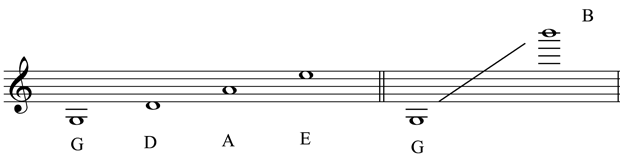
Ranges of the violin, from Google Images

Pitch range of the violin, Google Images
The bridge is a wooden device that supports the strings on the violin. It stands on the belly between the f holes. It is very important for the functioning of the instrument because it transfers some of the energy of vibration of the string to the body of the violin, which transfers the sound to the surrounding air. The bridge connects two structures inside the violin: the sound post and the bass bar. The sound post goes all the way through the instrument, and it transmits high notes to the rigid back plate of the violin. The bass bar helps transmit bass notes to the more flexible front plate, allowing it to amplify the lower frequencies when played.
The bridge itself is very effective at transmitting power to the body at frequencies from about 1 to 4 kHz, which is where the ear is most sensitive. This is one of the reasons for the bright timbre of the violin.

Cross section at the bridge, seen from the tailpiece end. At low frequencies, the bridge oscillation approximates rotation around a point near the treble foot.
The f holes have two different functions. One is to connect the air inside to the air outside. The other is a result of their length: the part of the belly lying between the f holes can move more easily than can most of the wood of the body.
As also said previously, the body is composed with the front and back plates, the sides and the air inside. All of those elements serve to transmit the vibration of the bridge into vibration of the air around the instrument. For this, the violin needs a relatively large surface area so that it can push a reasonable amount of air backwards and forwards.
The most important part is the belly. The belly and back plates are made so that they can easily vibrate up and down. The plates have a number of resonances: there are certain frequencies at which they vibrate most easily.
The player can pluck or bow the violin strings in order to play it. There is a difference between these two ways of playing. A plucked string very quickly loses its high harmonics and, after a few seconds, nearly all of the remaining energy in the string is in its fundamental. Bowing inputs energy continuously to the string and thereby maintains the power in the high harmonics. The use of the bow is also very important to the violin sound. It allows the production of a maintaned note. The bow can be used in a variety of different ways to produce different articulations and sound effects.
The violin player creates sound by bowing one or more of the four strings. The bow hairs are rubbed in a sticky substance called rosin in order to make the strings stick to the bow.
There's friction between the string and the hairs of the bow. This friction causes the string to stick to the hairs until it's pulled enough for the tension of string to overcome the friction, causing it to slip, and then this repeats hundred of times a second. This is called stick-slip action. Here's a video to demonstrate:
Video of a bowed violin string in slow motion, provided by ViolinBOW
These oscillations happen many hundreds of times per second, for example, 196 times for the G string, (which is the lowest note on the violin in standard tuning), and into the thousands for very high notes.
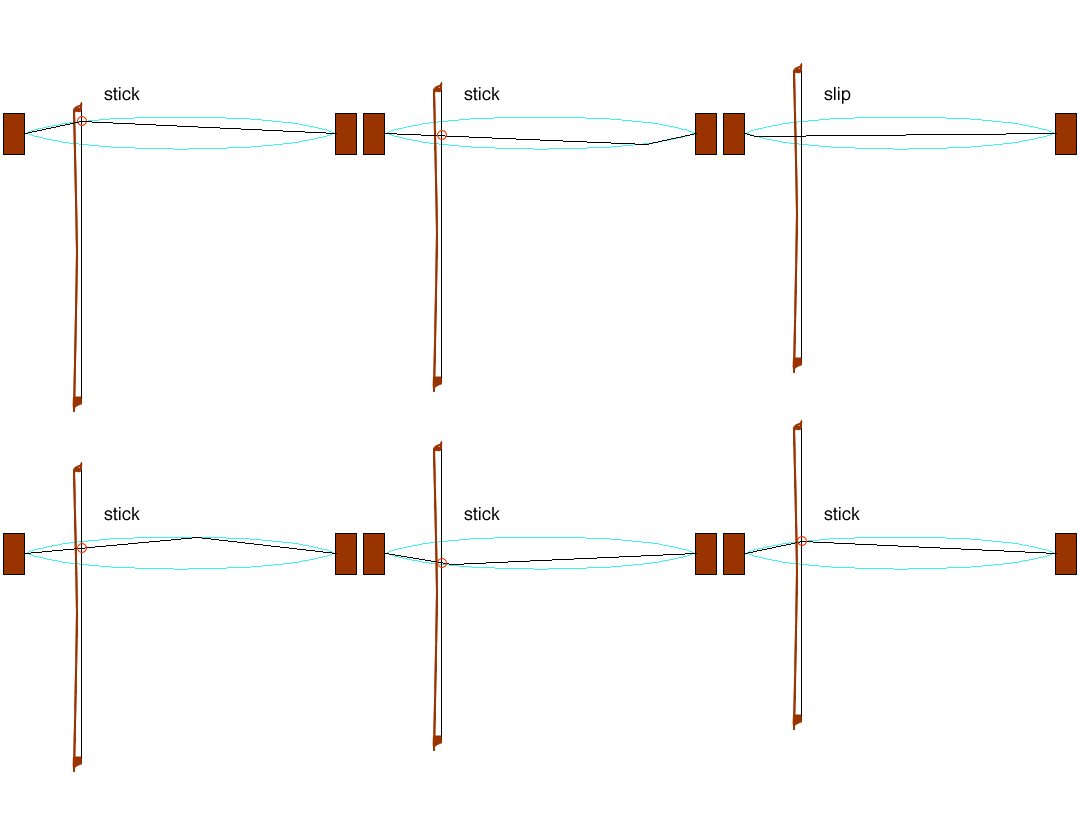
An animation showing the slip-stick motion of the bow on the violin string. From Violin acoustics, University of New South Wales. © Heidi Hereth
The strings themselves move almost no air and consequently produce almost no sound. As explained before, their vibrations are transmitted to the violin body through the bridge. The total tension of in the four strings is about 50 pounds, about 20 of which is directed straight down into the bridge (knowing that the tension formula is T = W +or- m*a, where, W = Weight of the body, m = mass of the body and a = acceleration of the moving body). When a string is bowed, a force is created in the direction of the bow’s motion. As the bow pulls the string along, the force on the bridge increases in the direction of bowing. When the string slips, the force reverses direction to be opposite from the bow’s motion. Thus the force transmitted to the bridge takes the form of a sawtooth wave.
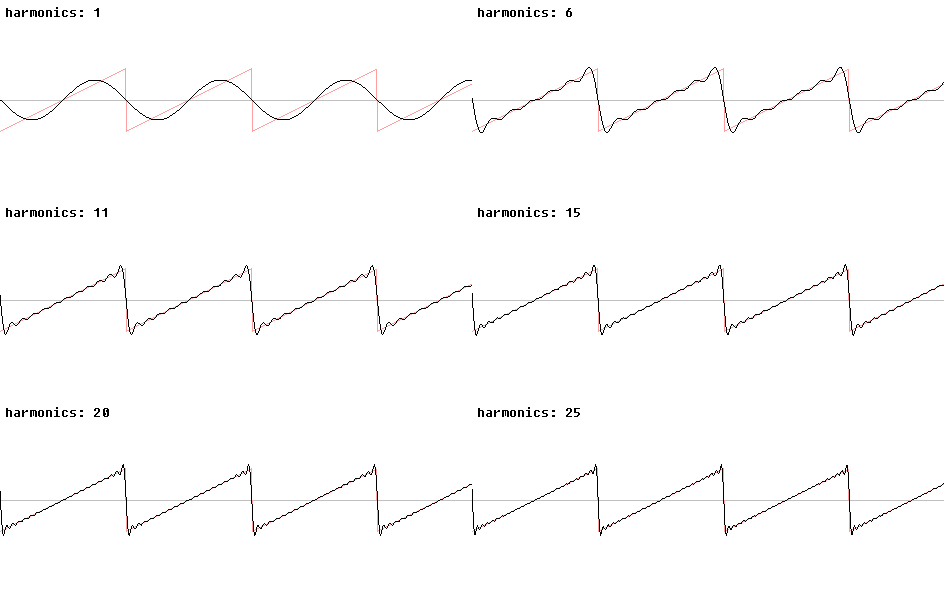
An illustration of a sawtooth wave on a string (with 25 harmonics as an example).
Animation provided by Physics Central.
Any such periodic wave can be analyzed as a total of pure tones, such as what we hear when we strike a tuning fork. Thus, when a violinist bows a string, he or she not only produces the fundamental pure tone that he or she is trying to play, but also many harmonics, which are notes with frequencies that are integer multiples of the fundamental. For example, when a violinist bows the string A4 (=LA), which has a fundamental frequency of 440 cycles per second, the sound you hear contains pure tones of frequency not only 440 cycles per second, but also 880 (=440+440), 1320 (=440+880), 1760 (=440+1320), and so on. In the case of the sawtooth wave (as seen above), the fundamental harmonic is twice as strong as the second harmonic, three times as strong as the third harmonic, and so on.
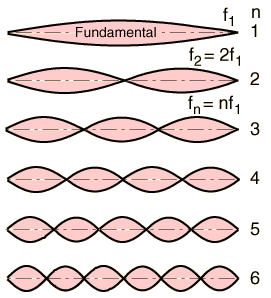
An illustration of harmonic waves on a string, provided by Physics Central
An ideal vibrating string will vibrate with its fundamental frequency and all harmonics of that frequency. The position of nodes and antinodes is just the opposite of those for an open air column.
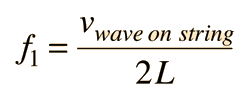
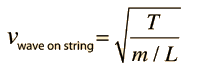
The fundamental frequency can be calculated from
where
T = string tension
m = string mass
L = string length
and the harmonics are integer multiples.
How should a violin be played and what are the required conditions ?
As explained previously, violin produces sound through the vibration of its strings, which occurs when the player sets them in motion, by either drawing the bow over the strings or by plucking it.
The violinist's technical approach is solely responsible for obtaining the resulting quality and type of sound. It also depends on the material that constitutes the violin's body and its strings. The size and shape of the violin, and the thickness and length of a violin's strings is what characterizes its frequencies produced.
There are no sounds in nature that resemble the violin's sound, so descriptions of it are uneasy.

The construction of violin is such that it can be played below the neck and placed on the left shoulder.
To produce a note, the violinist first uses the left hand to press a position on the strings to the fingerboard at various places. This restrict the length of the strings that vibrate. He can adjust the note produced by any one string. Then, the player draws the bow across the string or strings, altering the speed and force to adjust the loudness and characteristics of the notes. From there, the construction of the violin takes over, amplifying the sound for the audience.
A correct posture establish the foundation for beautiful playing. Good standing and sitting positions are all important for optimum performance.
Good standing and sitting positions are important. Standing straigh (either standing up or sitting on a chair), keeping the head high, keeping the shoulder relaxed, keeping the knees flexed, centering the weight equally on both feet, keeping the spine straight are all important for optimum performance. Focusing all of the movement on the hands and focusing on the music participates to get good sound.
Schema showing a good violin playing posture, provided by Google Images.